How it works
AI and expert knowledge scale existing digitization
The digitization of large real estate portfolios is considered a mammoth task – expensive, slow, and full of risks. Together with Vienna International Airport, Points2BIM shows how a new hybrid process combining AI and expert knowledge addresses these challenges.
Dec 2, 2025
1. Digitalization requires planning – no surprises.
Through AI-based pre-structuring, model delivery times and costs can be reliably calculated for the first time.
2. Use-case-first instead of LOD-overkill.
Not every model needs to be maximally detailed. What matters is what it is used for – from operation to renovation.
3. AI does not replace experts, it enhances them.
Automated basic models create speed, experts provide precision and validation.
4. Portfolio digitization becomes possible.
With standardized workflows, digitization can transform from a single project to a permanently lived business practice.
5. Data quality is a financial lever.
Unclear geometries lead to disruptions, claims, and poor decisions – precise models prevent costly risks.
6. Assets are constantly changing.
Regular updates are the new standard – not just project completion. Tools like Portfolio+ provide the foundation for this.
The digitalization of existing buildings is a strategic goal for many companies – but in reality it often remains expensive, slow, and risky. Outdated existing plans, poor data quality, and unpredictable modeling processes complicate the introduction of digital twins and BIM-based workflows.
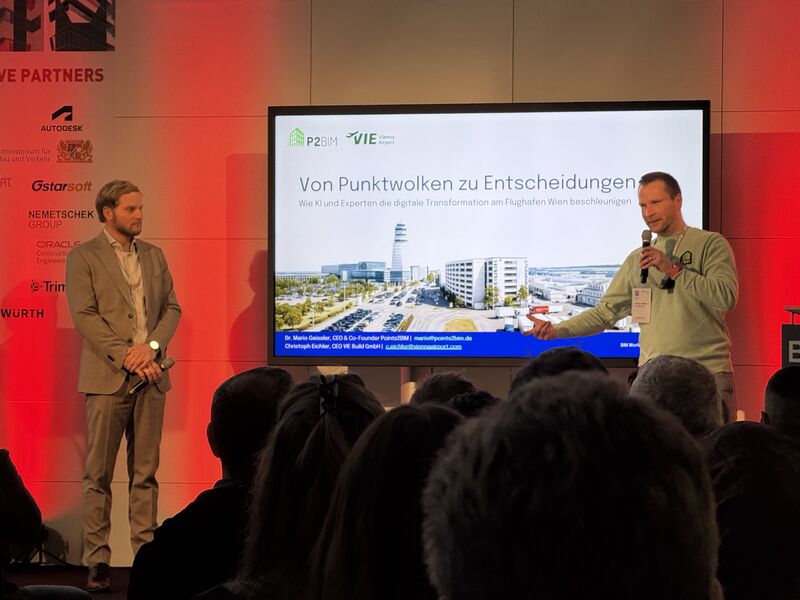
Together with Vienna International Airport, Points2BIM demonstrates how modern technologies can overcome these hurdles. Our CEO Dr. Mario Geißler and Christoph Eichler explain how automated BIM models from point clouds, AI-supported processes, and a clear use-case strategy can accelerate the digitalization of large holdings – economically, reliably, and scalably.
Why digitalization of existing buildings is more important today than ever before
Whether property owners, facility managers, airports, universities, hospitals, or industrial enterprises: Almost all holders of existing properties face the same challenges:
Existing plans are outdated or incomplete
Renovations are often not documented
Data is contradictory or inaccurate
Decisions are based on uncertain foundations
Digitalization often ends after individual pilot projects
The problem
Without precise existing data, it is impossible to integrate operating systems or make reliable construction economic decisions.
Vienna International Airport is a prime example of this complexity:
150 buildings with different uses
1,000 renovations per year
Highly complex above-ground and underground infrastructure
Nevertheless, investments in the millions must be made – based on data that is often unreliable.
Why pure manual modeling of point clouds fails
The current market standard is the manual modeling of point clouds in BIM software. However, this approach hits clear limits when an entire building stock is to be digitized.
Typical problems of manual BIM modeling:
High personnel needs and skilled labor shortages
Unpredictable lead times
Strong dependence on individual modelers
High costs with larger scopes
Qualitative fluctuations between projects
No standardization, only custom solutions
The result
Digitalization remains a flagship project, but not a scalable process.
The Points2BIM approach: Automatically creating point clouds to BIM – supported by experts
Points2BIM combines AI-based automated model creation with human expertise. This hybrid method is the foundation of industrial digitalization of existing buildings.
Step 1: AI creates the basic BIM model
Automated detection of walls, ceilings, columns, openings, etc.
Modeling at LOD 200 as a reliable starting point
Consistent quality and high speed
Step 2: Expert modeling refines the model
Validation, correction, and elaboration of critical components
Supplementing project-specific requirements
Ensuring standards, accuracy, and usability
Result:
A precise, up-to-date, and cost-effective digital building model that can be perfectly integrated into facility management systems, renovation processes, or portfolio decisions.
Our CEO Dr. Mario Geißler puts it aptly:
“The AI builds the framework – our experts develop it into a reliable BIM model.”
The most important success factor: Use-Case-First instead of LOD Fetish
Many digitalization projects fail because the LOD (Level of Development) is defined first. The first question should be:
“What do we need the data for?”
Because:
Too much detail can be harmful – especially in operation.
Too little detail can block renovation projects.
That's why Points2BIM relies on a use-case-based modeling strategy:
Should the model locate disruptions?
Is it intended for area evaluation?
Is it needed for renovations or technical planning?
Or for integration into a CAFM/BOS system?
Only then is the appropriate LOD determined.
Christoph Eichler says:
“Not every geometry helps. For operations, clarity matters, not detail depth.”
The use cases of Vienna International Airport (transferable to any property owner)
Use Case 1: Operations & Facility Management (Building Operation System)
The airport implements a comprehensive operating system that requires BIM data.
For this, all 150 objects are digitized.
Use Case 2: Renovations & Extensions (Scan to BIM for projects)
With 1,000 renovations annually, reliability is crucial.
In-house laser scan teams + Points2BIM result in:
Predictable lead times
Consistent quality
Fewer claims
Secure quantities & foundations
Use Case 3: Ongoing updates of existing data (Portfolio+)
Stocks change continuously.
Therefore, Points2BIM offers a solution to keep models continuously up to date – a central need for any modern facility management.
Economic benefits: Why automated BIM models are worthwhile for property owners
50–70% time savings
Predictable delivery times → predictable projects
Relieving skilled personnel
Massive cost reductions for large portfolios
Uniform model standards
Foundation for digital facility management
Reduction of claims & erroneous decisions
High quality thanks to hybrid validation processes
Digitalization transforms from a cost block to a productivity factor.
Conclusion: Digitalization of existing buildings as an industrial standard process
The combination of AI and expert knowledge finally makes it possible to efficiently digitalize entire portfolios – not just individual pilot buildings.
The key:
Automated BIM modeling from point clouds
Use-Case-First strategy
Standardized workflows
Updatable data models
Hybrid processes of AI + expertise
This creates the foundation for property owners to finally:
Create digital twins
Efficient facility management
Reduce operating costs
Accelerate renovation projects
Make strategically sound portfolio decisions