How it works
Reimagined Scan-to-BIM
With just a few clicks to precise inventory data in BIM quality. Discover how Points2BIM automates the labor-intensive scan-to-BIM process for asset managers, architects, surveyors, and construction experts, saving days of work. Learn more now!
Nov 23, 2025
In this post, you will learn:
What Scan-to-BIM actually is
Where the biggest time wasters and sources of error are
How Points2BIM automates the entire process
What advantages this brings for planning, costs, and speed
How you can obtain a usable BIM model from your point cloud in just 3 hours
The Future of Building Inventory: Faster, More Accurate, and Digital
The digitalization of the construction industry is developing rapidly – and with it, Scan-to-BIM is gaining more and more importance. Whether architects, planners, engineers, or construction companies: Anyone working with existing buildings can hardly do without precise digital models. But this is where the challenge lies.
What happens in the daily lives of many companies today is a time-consuming process: Point clouds are scanned, manually modeled, and then painstakingly checked. This takes days, sometimes weeks – and often a chain of errors arises that delays projects and drives up costs.
What is Scan-to-BIM – and why does it take so long?
Scan-to-BIM describes the path from the physical building through the 3D point cloud to the digital BIM model. The process begins with a laser scan or photogrammetry capture that generates millions of measurement points. This point cloud shows the real state of a building with millimeter precision.
Traditionally, a manual modeling process follows, where employees identify, trace, and parameterize building components. This is prone to errors, costly, and slow.
Points2BIM revolutionizes the Scan-to-BIM process
This is where Points2BIM comes in – with an automated process that converts point clouds into a complete BIM model in the shortest possible time. This is made possible by modern algorithms, artificial intelligence, and an optimized workflow.
“With Points2BIM, you receive a basic model in hours – a process that used to take weeks.”
Marlena Ludwig, BIM Expert at Points2BIM
The Process Step by Step
Capture point cloud
A professional scan forms the starting point. A high-quality point cloud is crucial for a precise model.
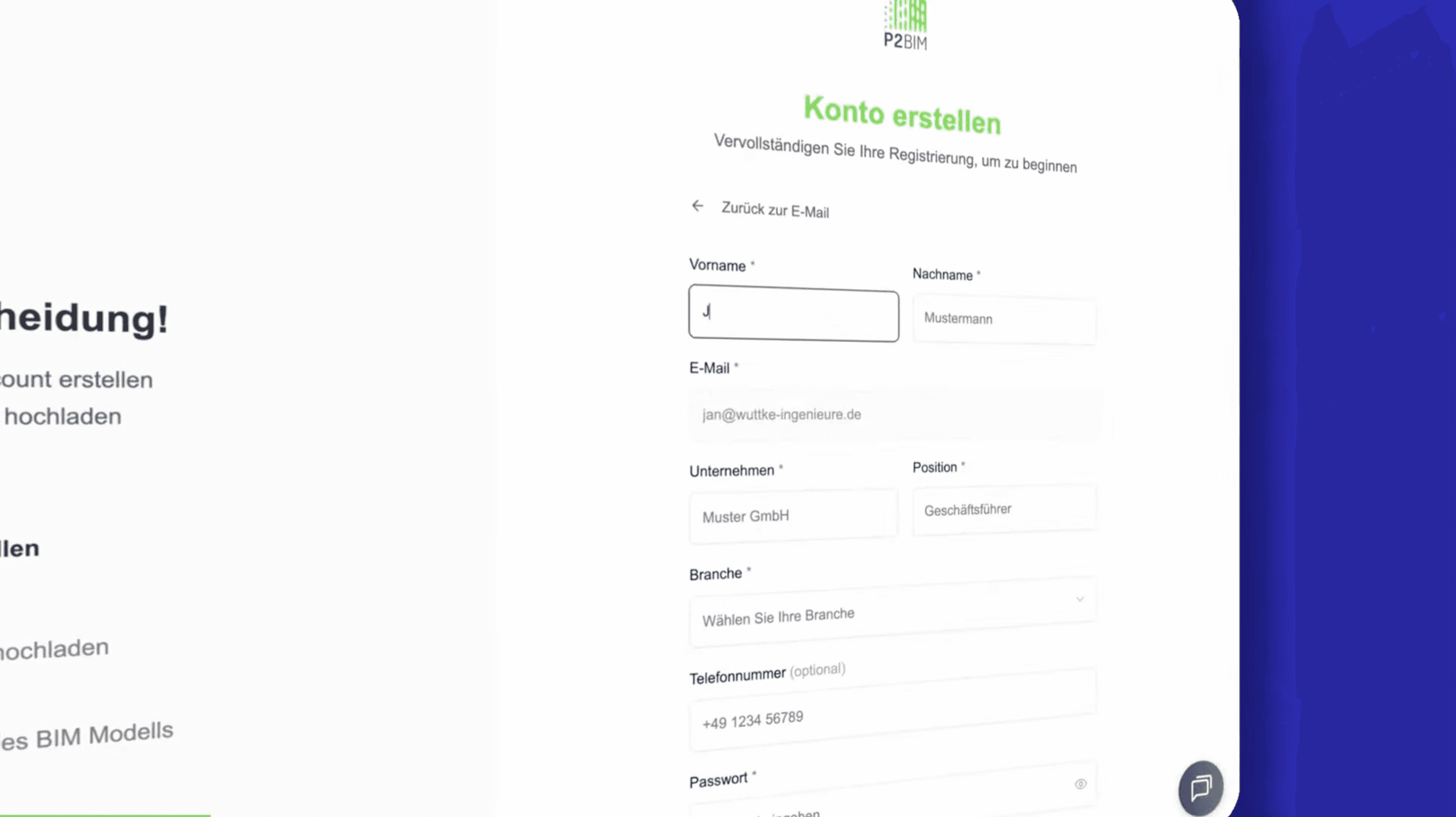
Upload to the Points2BIM platform
The point cloud is uploaded and automatically analyzed.Automated modeling
The system autonomously recognizes building components such as walls, doors, windows, ceilings, or levels.
Manual expert review
Despite automation, an experienced BIM specialist reviews each model thoroughly to ensure the highest quality.
Download & Further Use
The completed model is available in Revit, ArchiCAD, or IFC format and can be used in various ways:
for area analyses, approvals, renovation planning, or technical assessments.
The Advantages of Points2BIM at a Glance
Enormous time savings
A process that used to take four to five days is reduced to three hours.
Cost efficiency
With prices starting from €1/m², the solution is particularly economical for larger projects.
Highest flexibility
IFC models are compatible with Revit, Archicad, Allplan, and other tools.
Precision and quality
State-of-the-art algorithms and software like Leica Cyclone ensure accuracy of up to 2 cm.
Why Scan-to-BIM with Points2BIM is Worth It
Efficiently converting point clouds into BIM models has long been a challenge. Points2BIM shows that it can also be done differently: faster, more accurately, and significantly more cost-effectively. The solution offers companies an advantage, especially when resources are tight or deadlines are close.
“Whether small or large projects – Points2BIM accelerates the entire Scan-to-BIM process and reduces sources of error.”
Marlena Ludwig
Conclusion: The Easiest Way from Scan to Model
With Points2BIM, Scan-to-BIM becomes a fast, automated, and reliable process that significantly improves project efficiency. Those who take the digitalization of existing structures seriously will find the ideal solution here.